

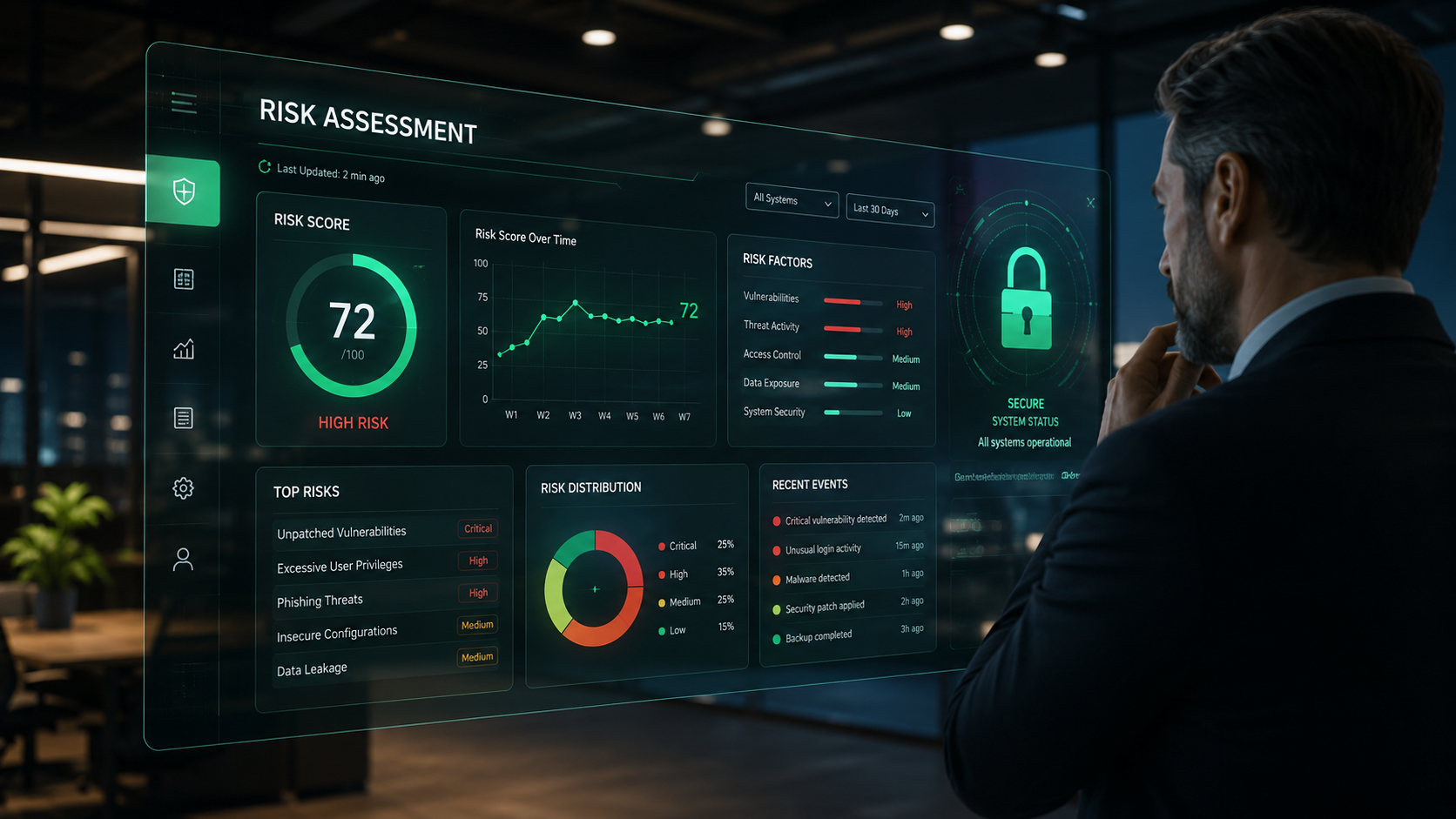
Cybersecurity Risk Assessment: The Complete Guide to Identifying & Reducing Business Cyber Risks (2026)
Most businesses don’t discover their cybersecurity gaps until something goes wrong. A phishing email gets through, a former employee’s credentials remain active, or a software vulnerability that’s been sitting unpatched for months gets exploited. A cybersecurity risk assessment identifies those gaps before an attacker does.
This guide explains what a risk assessment actually involves, how to run one, and what to do with the results.
What Is a Cybersecurity Risk Assessment?
Definition Explained in Simple Terms
A cybersecurity risk assessment is a structured process for identifying the threats, vulnerabilities, and potential consequences affecting your organization’s data and systems. The result is a clear picture of where your greatest exposure sits and what it would take to reduce it.
It’s not a one-time audit or a checklist exercise. It’s a working methodology that helps leadership make informed decisions about where to spend security resources.
Why Every Business Needs a Cybersecurity Risk Assessment
No business is too small to be targeted, and no business has an unlimited IT budget. A risk assessment answers both realities at once — it tells you which threats are realistic for your environment and which controls will have the most impact. Without it, security spending tends to be reactive and scattered.
Cybersecurity Risk Assessment vs Vulnerability Assessment
A vulnerability assessment finds specific technical weaknesses — unpatched software, misconfigured systems, open ports. A risk assessment goes further: it evaluates the likelihood and business impact of those vulnerabilities being exploited. A vulnerability assessment is a data input. A risk assessment is the analysis that tells you what to do about it.
Cybersecurity Risk Assessment vs Security Audit
A security audit measures whether your current controls meet a defined standard or policy. A risk assessment evaluates whether those controls are actually reducing your exposure to the threats that matter most to your business. Both are valuable, but they answer different questions. Use the right one for the decision you need to make.
Why Cybersecurity Risk Assessments Are Important
The average cost of a data breach reached USD 4.88 million in 2024, according to IBM’s annual report — and smaller businesses often face proportionally larger impacts because they have fewer resources to absorb the disruption. A risk assessment doesn’t guarantee you’ll never face an incident, but it significantly reduces the likelihood of preventable ones.
For regulated industries, risk assessments aren’t optional. PIPEDA, HIPAA, PCI DSS, and most cyber insurance policies either require regular assessments or use them to determine coverage terms and premiums. Skipping them creates both operational and legal exposure.
Beyond compliance, a risk assessment gives leadership a business-language view of security: not a list of CVEs, but an honest answer to “what could go wrong, how likely is it, and what would it cost us.”
What Are the Key Components of a Cybersecurity Risk Assessment?
Every effective risk assessment covers the same core elements, regardless of the framework or methodology used.
- Asset inventory — what systems, data, and infrastructure you’re protecting
- Threat identification — the realistic attack scenarios that apply to your environment
- Vulnerability analysis — where weaknesses exist that threats could exploit
- Likelihood and impact scoring — how probable each risk scenario is, and what the business consequences would be
- Risk prioritization — ranking risks so resources go to the most significant exposures first
- Control recommendations — specific, actionable steps to reduce each identified risk
- Residual risk documentation — what risk remains after controls are applied, and whether that’s acceptable
Common Cybersecurity Risks Businesses Face
Risk profiles vary by industry, size, and how a business uses technology — but certain patterns show up consistently across SMBs in Canada.
- Credential-based attacks: stolen or reused passwords remain the most common entry point for breaches
- Phishing and business email compromise: employees receive convincing fraudulent messages and act on them
- Ransomware: attackers encrypt systems and demand payment, often after first exfiltrating data
- Unpatched software: known vulnerabilities in operating systems, applications, and network devices
- Third-party vendor access: suppliers and contractors with credentials to your environment, creating unmonitored exposure
- Cloud misconfigurations: storage buckets, access policies, or permission settings that expose data unintentionally
- Insider risk: former employees with active access, or current staff with more permissions than their role requires
Step-by-Step Cybersecurity Risk Assessment Process
A thorough risk assessment follows a consistent sequence. The time required varies by organization size, but the steps don’t change.
Step 1: Define the Scope
Decide which systems, locations, and data types the assessment will cover. A focused scope produces more useful results than trying to assess everything at once.
Step 2: Identify and Catalogue Assets
Build an inventory of every system, application, device, and data repository within scope — including cloud environments and third-party integrations.
Step 3: Identify Threats
Map the realistic threat scenarios that apply to your environment. These include external attacks, insider risk, accidental exposure, and natural or physical disruptions.
Step 4: Identify Vulnerabilities
Evaluate each asset for weaknesses — missing patches, weak access controls, insecure configurations, or gaps in monitoring — that the identified threats could exploit.
Step 5: Analyze Existing Controls
Document what security controls are already in place and assess how effectively they reduce the identified risks. This prevents double-counting effort and highlights where gaps actually exist.
Step 6: Calculate Likelihood and Impact
Assign a score to each risk based on how likely exploitation is and what the consequences would be to the business — financial loss, operational downtime, regulatory penalty, or reputational damage.
Step 7: Prioritize Risks
Use the likelihood and impact scores to rank risks. High-likelihood, high-impact scenarios get addressed first, regardless of how technically complex they are.
Step 8: Recommend Controls
For each prioritized risk, define the specific control or mitigation that will reduce it — whether that’s enabling MFA, patching a system, restricting access, or adding monitoring.
Step 9: Document Residual Risk
After applying controls, document the exposure that remains. Some risk is unavoidable. Leadership should formally acknowledge acceptable residual risk rather than assume it doesn’t exist.
Step 10: Review and Repeat
A risk assessment is a point-in-time snapshot. New systems, staff changes, vendor additions, and evolving threats mean the picture changes. Build a schedule for regular reassessment from the start.
Cybersecurity Risk Assessment Frameworks
Several established frameworks provide structure for how to conduct and document a risk assessment. The right one depends on your industry, size, and compliance obligations.
| Framework | Best For | What It Covers |
|---|---|---|
| NIST CSF | Any industry — strong general baseline | Govern, Identify, Protect, Detect, Respond, Recover |
| ISO/IEC 27001 | Enterprise, international operations | Full ISMS policies, controls, continuous improvement |
| CIS Controls | SMBs wanting practical prioritized controls | 18 control families from basic hygiene to advanced defences |
| SOC 2 | SaaS providers, service organizations | Security, availability, confidentiality, privacy controls |
| PCI DSS | Any business processing payment cards | Cardholder data protection, network segmentation, monitoring |
| HIPAA | Healthcare, health data handlers | Protected health information (PHI) safeguards and breach response |
Choosing the Right Framework
Most SMBs in Canada start with NIST CSF or CIS Controls — both are well-documented, practical, and don’t require formal certification to use. If you operate in healthcare, process payments, or serve enterprise clients that require proof of security posture, the compliance-specific frameworks become relevant. In most cases, a good managed IT provider can guide this selection based on your actual obligations rather than the most complex option.
Types of Cybersecurity Risk Assessments
Risk assessments can be scoped broadly across an organization or focused on a specific area. Common types include network risk assessments (evaluating the security of your infrastructure, firewalls, and remote access), cloud security assessments (reviewing access controls, configurations, and data protection in cloud environments), web application assessments (testing externally facing systems for exploitable vulnerabilities), endpoint security assessments (examining device management, patching, and endpoint protection), third-party risk assessments (evaluating supplier and vendor access and security practices), and compliance risk assessments (measuring current controls against a specific regulatory standard).
Each type produces different findings and serves a different purpose. Most organizations benefit from a broad baseline assessment followed by targeted assessments in areas where the initial findings reveal higher risk.
How to Calculate Cybersecurity Risk
The standard formula is straightforward: Risk = Likelihood × Impact. Both variables are typically scored on a scale of 1 to 5, producing a risk score between 1 and 25. Scores above 15 generally indicate high risk requiring immediate attention. Scores between 8 and 15 are medium risk, requiring a planned response. Scores below 8 are lower priority but should still be documented.
In practice, the scoring should reflect real business context — not just technical severity. A vulnerability on a system that handles client financial data carries more business risk than the same vulnerability on an isolated internal server, even if the technical exposure is identical.
Cybersecurity Risk Assessment Checklist
Use this as a starting reference before beginning or reviewing a risk assessment.
- Scope defined — systems, data, locations, and users covered are documented
- Asset inventory complete — all hardware, software, cloud services, and data stores identified
- Threat scenarios mapped — relevant external, internal, and accidental threats listed
- Vulnerabilities catalogued — technical and procedural weaknesses identified per asset
- Existing controls documented — current security measures and their effectiveness noted
- Risk scores assigned — likelihood and impact calculated for each risk scenario
- Risks prioritized — a ranked list with recommended remediation actions
- Residual risk documented and accepted — leadership has reviewed and acknowledged remaining exposure
Essential Tools for Cybersecurity Risk Assessment
The right tools depend on the scope and depth of the assessment. Vulnerability scanners such as Nessus, Qualys, and OpenVAS identify technical weaknesses across networks and endpoints. Microsoft Secure Score provides a continuous view of security posture within Microsoft 365 and Azure environments. Network mapping tools like Nmap help build an accurate picture of what’s actually running on your network. GRC platforms such as OneTrust and LogicGate manage the documentation, risk scoring, and tracking that formal assessment requires. For most SMBs, the challenge isn’t access to tools — it’s having the expertise to interpret and act on what they surface.
Common Mistakes Businesses Make During Risk Assessments
- Treating it as a compliance exercise rather than a business tool — producing a document that gets filed and forgotten
- Scoping too broadly from the start — a sprawling assessment loses focus and produces findings too generic to act on
- Skipping asset inventory — you can’t assess risk to systems you don’t know exist
- Underestimating third-party risk — vendor and supplier access is frequently the weakest link in an otherwise solid security posture
- Assigning risk scores without business context — a 9.8 CVSS score on an isolated internal system may matter less than a 6.5 on a customer-facing application
- No remediation tracking — the assessment identifies the risks, but nobody is formally responsible for fixing them
- Conducting it once and never repeating it — a risk assessment from two years ago reflects a different environment than the one you’re operating in today
Best Practices for Effective Cybersecurity Risk Management
The most effective risk management programmes treat the initial assessment as a starting point rather than a destination. The findings should feed directly into a remediation plan with assigned ownership, deadlines, and a way to track progress. Risks that can’t be remediated in the near term should be formally accepted by leadership — not ignored.
Communication matters as much as the technical work. Leadership needs to understand risk in business terms — operational disruption, regulatory exposure, customer trust — not just vulnerability counts and CVSS scores. That’s what drives the resource allocation decisions that actually reduce risk.
Continuous monitoring between formal assessments keeps the picture current. Log review, security alerts, and change management processes catch new risks as they emerge rather than waiting for the next scheduled assessment cycle.
How Often Should You Conduct a Cybersecurity Risk Assessment?
For most SMBs, an annual comprehensive risk assessment is the right cadence to start. Organizations in regulated industries or those that have experienced a recent incident, significant growth, or major technology changes should assess more frequently — typically every six months.
Outside of scheduled assessments, certain events should trigger an immediate review: adding a new cloud platform or major application, a merger or acquisition, a significant staff change in IT or leadership, or a breach at a vendor or peer organization in your industry. The trigger isn’t calendar-based — it’s change-based.
Signs Your Business Needs a Cybersecurity Risk Assessment Immediately
- You’ve never conducted a formal risk assessment or haven’t done one in over 12 months
- A security incident, near-miss, or successful phishing attempt has occurred recently
- Your business has grown, added new technology, or moved data to the cloud without a corresponding security review
- You’ve onboarded new vendors or suppliers with access to your systems or data
- A client or partner has asked you to demonstrate your security posture
- Your cyber insurance renewal is approaching, and you want to understand your coverage position
- Your team spends more time responding to IT issues than preventing them
Why Partner with a Managed IT & Cybersecurity Provider?
Conducting a meaningful risk assessment requires the ability to analyze technical findings, map them to business impact, and recommend controls that your team can actually implement. Most SMBs don’t have those capabilities in-house, and hiring them full-time isn’t realistic.
A managed IT and cybersecurity provider brings the tools, methodology, and industry context to conduct the assessment properly — and then stays engaged to help implement the findings, monitor for new risks, and keep the programme current between formal assessments. That’s a fundamentally different outcome than a one-time engagement with a consultant who hands over a report and moves on.
For businesses in regulated industries — legal, financial services, healthcare, law enforcement — working with a provider who understands those compliance environments directly reduces the time and cost of meeting those obligations.
Conclusion
A cybersecurity risk assessment isn’t a guarantee against incidents. It’s a structured way to understand where your real exposure sits, make informed decisions about where to invest in protection, and reduce the likelihood of preventable problems that make up the majority of breaches.
The businesses that handle incidents well aren’t the ones with the most sophisticated technology. They’re the ones that understood their risks before something happened — and had the controls, processes, and response plans ready when it did.
If your business hasn’t had a formal risk assessment in the past 12 months, that’s a gap worth closing. Contact the Tecbound team to discuss what a cybersecurity risk assessment looks like for your environment.
Frequently Asked Questions
What is a cybersecurity risk assessment?
A cybersecurity risk assessment is a structured process that identifies the threats, vulnerabilities, and potential business impacts that apply to your organization’s systems and data — and prioritizes the controls needed to reduce that exposure.
Why is a cybersecurity risk assessment important?
It gives leadership an accurate, business-context view of where security gaps exist and what they could cost the organization. Without it, security spending tends to be reactive and misaligned with actual risk.
What are the five steps of a cybersecurity risk assessment?
The core steps are: identify and inventory your assets, identify relevant threats and vulnerabilities, calculate the likelihood and impact of each risk scenario, prioritize risks by business significance, and recommend specific controls to reduce the highest-priority exposures.
How often should a cybersecurity risk assessment be performed?
Annually for most businesses. More frequently — every six months — for regulated industries or after major changes such as cloud migrations, acquisitions, or significant staff turnover.
What is the difference between a risk assessment and a vulnerability assessment?
A vulnerability assessment finds specific technical weaknesses. A risk assessment uses those findings as inputs, then evaluates which weaknesses pose the most significant business risk based on likelihood of exploitation and potential impact.
What frameworks are used for cybersecurity risk assessments?
NIST Cybersecurity Framework and CIS Controls are the most widely used for general business environments. ISO/IEC 27001 applies to organizations seeking formal certification. PCI DSS, HIPAA, and SOC 2 apply in their respective regulated industries.
Who should perform a cybersecurity risk assessment?
It can be conducted internally by a qualified IT or security team, or externally by a managed IT provider or cybersecurity firm. External assessors bring objectivity and industry context that internal teams often lack, particularly for SMBs without dedicated security staff.
How long does a cybersecurity risk assessment take?
For a small business with a defined scope, two to four weeks. For larger organizations with complex environments, one to three months. The scoping and asset inventory phases are typically where the most time is spent.
What tools are used for cybersecurity risk assessments?
Common tools include vulnerability scanners (Nessus, Qualys), network discovery tools (Nmap), Microsoft Secure Score for M365 environments, and GRC platforms for documenting and tracking risk findings. The tools provide data; the assessment methodology determines what to do with it.
What is included in a cybersecurity risk assessment report?
An executive summary of key findings, the asset inventory and scope covered, identified risks with likelihood and impact scores, a prioritized remediation roadmap, documentation of existing controls and their effectiveness, and a residual risk statement for leadership review.
How much does a cybersecurity risk assessment cost?
For SMBs, a professionally conducted assessment typically ranges from $2,000 to $15,000 depending on scope and complexity. Organizations in regulated industries or with larger environments will be at the higher end. Some managed IT providers include assessment services as part of an ongoing managed security engagement.
Can small businesses benefit from cybersecurity risk assessments?
Yes — and they arguably need them more than large enterprises, because they have less capacity to absorb the financial and operational impact of a breach. A well-scoped assessment for a small business is also significantly less complex and expensive than one for a large organization.
What are the biggest cybersecurity risks for small businesses?
Credential theft and phishing, ransomware, unpatched software, third-party vendor access, and cloud misconfigurations account for the large majority of incidents affecting SMBs. These are also some of the most preventable with basic controls in place.
How do you calculate cybersecurity risk?
Risk = Likelihood × Impact. Both are scored on a defined scale — typically 1 to 5 — producing a risk score used to prioritize remediation. The scoring should reflect business context, not just technical severity ratings.
What happens after a cybersecurity risk assessment is completed?
The findings feed into a prioritized remediation plan with assigned ownership and timelines. High-risk items are addressed first. Risks that can’t be immediately remediated are formally documented and accepted by leadership. A follow-up review confirms that controls were implemented and reassesses residual risk.