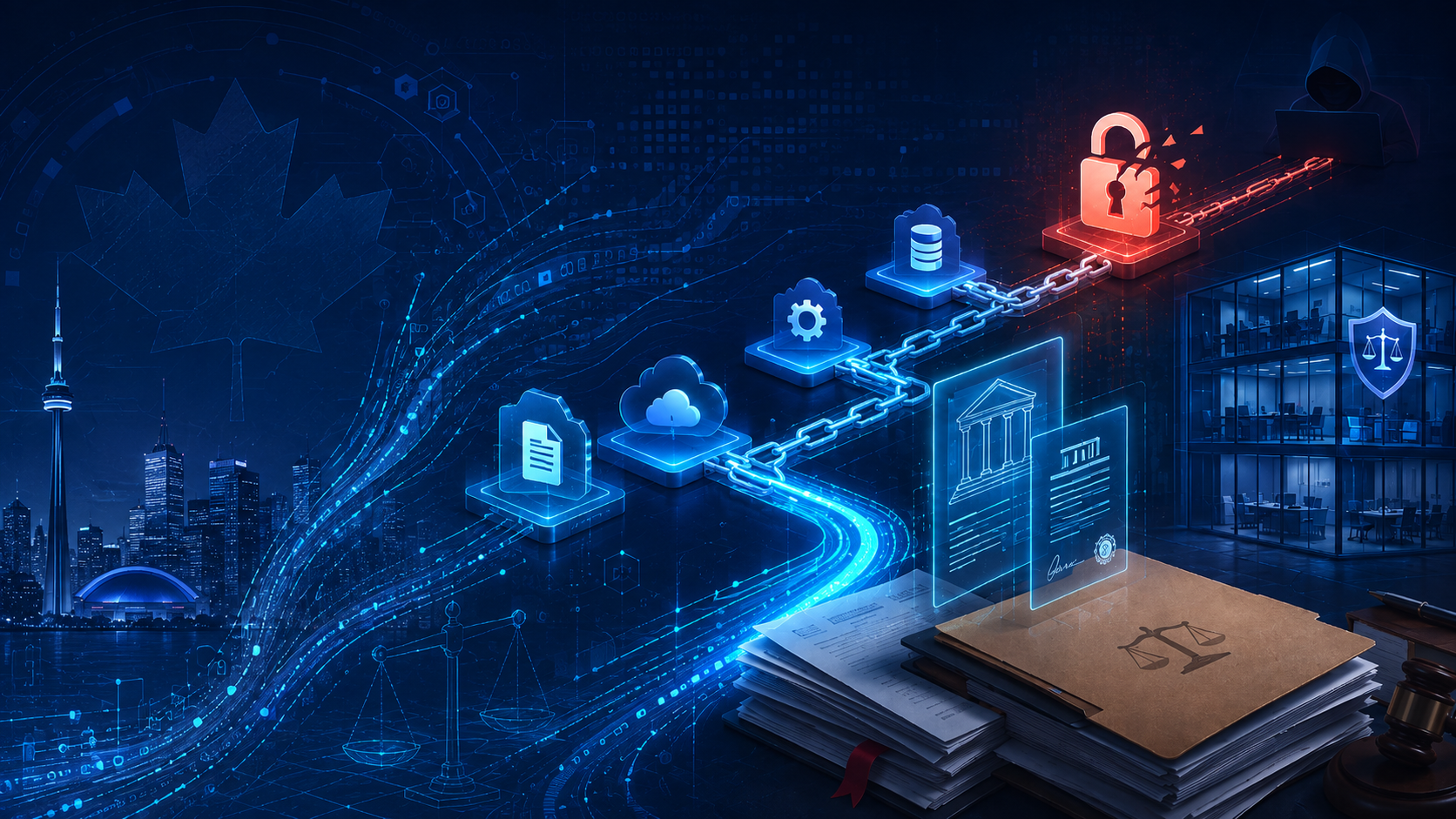

When a data breach hits, the first question leadership asks is usually “what was stolen?” But that question arrives too late. By then, the operational disruption has begun, the legal exposure is real, and the reputational damage is already underway, sometimes before the company even knows what happened.
The reason breaches are harder to prevent than ever is straightforward: businesses are more interconnected than they were five years ago. Cloud platforms, remote access, mobile devices, third-party software, and payment systems each add convenience and exposure. A single credential stolen from a contractor, or a cloud storage bucket configured with one wrong permission, can give an attacker everything they need.
IBM’s 2025 Cost of a Data Breach Report put the global average cost of a breach at approximately USD 4.4 million. It noted that environments where AI adoption is outpacing security governance tend to carry higher risk. The underlying point isn’t about AI specifically. It’s when systems grow faster than the controls around them that gaps appear.
No business is too small to be a target. The data that most companies hold, including client records, payment information, employee files, and contracts, has real value to attackers. Treating cybersecurity as a core business function, rather than a background IT task, is what separates organizations that recover quickly from those that don’t.
Most breaches don’t happen because of one catastrophic failure. They occur when several smaller weaknesses exist simultaneously and an attacker finds the overlap. These are the patterns that come up most often.
Payment card data, bank credentials, tax records, payroll details, and invoicing information are all high-value targets. Beyond the immediate fraud risk, financial breaches often trigger regulatory scrutiny and customer distrust that’s slow to repair.
Businesses handling payment data need tight controls around encryption, access management, and the security standards of every vendor in their payment chain.
Health information is among the most sensitive data a business can hold. It can’t be changed the way a compromised credit card number can, and the consequences of exposure for patients and for the organization can be severe.
IBM’s 2025 data puts the average cost of a healthcare breach at USD 7.42 million, the highest of any sector. The combination of regulatory obligations, litigation exposure, and patient harm makes this category especially costly.
Not all stolen data shows up immediately. Trade secrets, client lists, proprietary pricing models, source code, and internal strategy documents can be taken and used quietly for months before the impact becomes visible.
For professional services, construction firms, law practices, and technology companies, this kind of breach can affect competitive position and client trust long after the incident itself.
Public sector organizations carry a specific kind of exposure: the data they hold often touches public safety, law enforcement operations, or citizen services. A breach in this environment isn’t just a financial issue; it can affect institutional trust and operational continuity in ways that are difficult to quantify.
Legacy systems, constrained budgets, and high public accountability make this sector particularly challenging to protect.
The 2013 Target breach remains one of the clearest examples of how attackers move laterally through an environment. Entry came through a third-party HVAC vendor, and the attackers eventually reached point-of-sale systems across the retail network. The incident led to an $18.5 million multistate settlement.
The Equifax breach in 2017 exposed personal information belonging to roughly 147 million people. A known software vulnerability went unpatched for months, giving attackers extended access. The FTC settlement reached up to $425 million in consumer relief.
The 2019 Capital One incident is particularly relevant for Canadian organizations. According to Capital One’s own disclosure and subsequently confirmed by Canadian regulators, the breach affected roughly 6 million Canadians in addition to approximately 100 million Americans — one of the largest exposures of Canadian consumer data on record. A cloud misconfiguration was the entry point. The OCC assessed an $80 million civil penalty. (See also: Roland Dumont Agency, August 2019 — https://www.dumontagency.com/2019/08/)
The Change Healthcare cyberattack in 2024 showed how dependent entire sectors can become on a single vendor. When that vendor goes down, the disruption doesn’t stay contained. HHS confirmed approximately 190 million individuals were affected by the largest healthcare breach ever reported in the United States.
Each of these incidents reinforces the same underlying point: cybersecurity failures don’t stay inside the IT department. They move into customer service, billing, legal, operations, and executive credibility.
The patterns that emerge across these cases are consistent. Security alerts need to be investigated when they appear, not after the fact. Third-party access has to be actively monitored, not assumed to be safe. Sensitive data must be encrypted and segmented so that access to one system doesn’t mean access to everything. And incident response plans that have never been tested under realistic conditions offer far less protection than organizations expect.
The measurable costs of a breach — forensic investigation, legal fees, regulatory fines, notification expenses, system restoration — are significant. But the harder number to capture is the reputational cost.
Customers generally understand that security incidents happen. What they remember is how a company communicated, how quickly it acted, and whether leadership treated the incident as a serious business matter or as a PR problem to manage. Trust lost through a poorly handled breach is much harder to rebuild than the systems themselves.
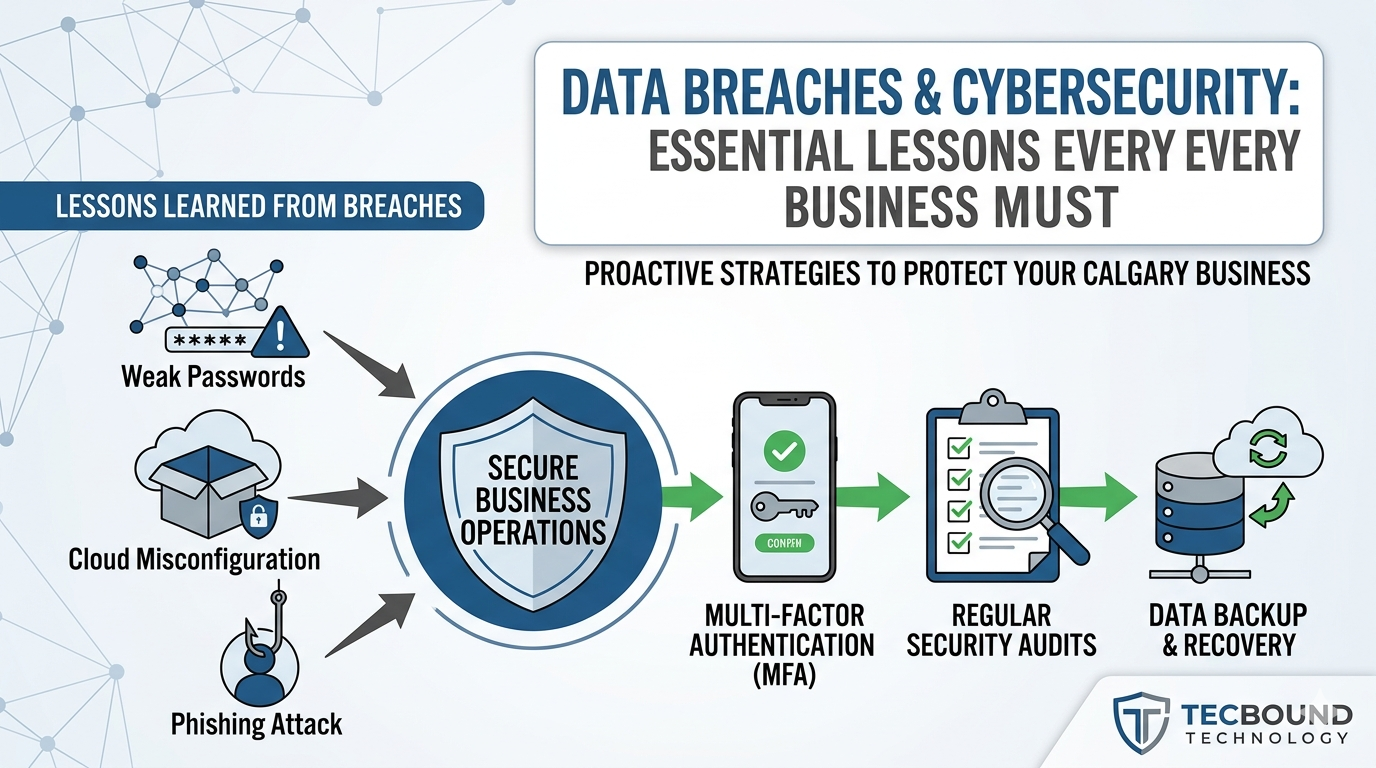
The consistent lesson across hundreds of documented breaches is that no single control is enough. Prevention, detection, response, and recovery have to work as a system. Organizations that treat any one of those as optional tend to find out why the hard way.
A more useful framing than “are we protected?” is a set of operational questions every leadership team should be able to answer: What data do we actually hold? Where is it stored, and who can reach it? What would happen if a key system went offline for 72 hours? How quickly would we know if credentials were stolen? Those answers reveal more about the actual security posture than any vendor dashboard.
A password on its own has one fundamental problem: if it’s stolen, it’s immediately usable. MFA breaks that chain. By requiring a second form of confirmation, a code sent to a phone, a hardware token, or a biometric check, organizations ensure that stolen credentials alone aren’t enough to gain access.
MFA should be a non-negotiable requirement for email accounts, VPN connections, remote access tools, cloud applications, finance systems, and any platform that stores client or business data. The inconvenience of a second step is marginal compared to the cost of a credential-based breach.
A security audit is less about checking boxes and more about answering an honest question: where are the gaps? Outdated software, unused accounts with active permissions, internet-facing services without patches, and cloud configurations that haven’t been reviewed in a year are the things audits surface.
Patches for critical vulnerabilities should be applied quickly, particularly on systems exposed to the internet. VPNs, firewalls, email platforms, and remote access tools are consistently targeted because attackers know they’re often delayed in patching cycles.
Every device that connects to business data is a potential entry point — laptops, workstations, phones, and servers alike. Endpoint protection, device encryption, email filtering, and patch management together reduce the risk that any one compromised device becomes a wider problem.
Network segmentation matters for the same reason. If an attacker gains access to one part of the environment, segmentation limits how far they can move. The goal is to contain a breach, not just prevent entry.
Choosing a reputable cloud provider handles the infrastructure layer. It doesn’t handle the configuration decisions your team makes on top of it. Access controls, permission scopes, logging settings, encryption policies, and conditional access rules all require deliberate setup and regular review.
Cloud environments drift over time. Accounts that should have been removed stay active. Permissions that were granted for a project never get revoked. A quarterly review of who has access to what, and whether that access still makes sense, closes gaps before attackers find them.
Backups are the last line of defence against ransomware and destructive attacks. But a backup that has never been tested is essentially untested insurance; you won’t know if it works until the moment you need it most.
A practical backup strategy covers off-site or cloud-based copies, regular restore testing, encryption of the backup itself, and documented recovery procedures with clear time objectives. The question worth asking isn’t “do we have backups?” It’s “how long would it take to restore from them, and have we ever actually done it?”
Most cybersecurity problems are easier to address before they become incidents. The challenge is that businesses tend to engage with security reactively after a near-miss, after a vendor’s breach, or after an audit finding. That pattern is expensive.
A proactive strategy starts with knowing what you have. Not a rough estimate, but an actual inventory: every user account, device, application, data store, and external vendor that connects to the environment. You can’t protect something you’re not tracking.
From there, prioritize based on business risk. Email is attacked constantly. Financial systems carry regulatory exposure. Client databases are high-value targets. Remote access tools are a frequent entry point. The controls around these systems should be stronger than the controls around a shared printer.
NIST Cybersecurity Framework 2.0 organizes this work into six functions: Govern, Identify, Protect, Detect, Respond, and Recover. It’s a practical structure for small and mid-sized businesses to use without needing a large internal security team.
Most small and mid-sized businesses don’t have the internal bandwidth to manage cybersecurity as a continuous process. There are too many moving parts: patching cycles, endpoint monitoring, cloud configuration reviews, user access audits, backup verification, incident response planning and too few hours in the day.
A managed IT provider takes those responsibilities off the internal team and handles them on a consistent schedule. Patches get applied when they’re released. Security configurations get reviewed before they drift. Access gets cleaned up when someone leaves. Backups get tested before anyone needs them.
The more important function is strategic. A good managed IT partner helps leadership understand where the real risks sit, what the regulatory exposure looks like, and what a realistic incident response would involve. That conversation is more valuable than any single technical control.
AI is increasingly useful in cybersecurity, particularly for analyzing large volumes of events, identifying unusual login behaviour, and accelerating the triage of security alerts. Detection that used to take hours can now happen in minutes.
The risk, as IBM’s 2025 report flags, is governance. When AI tools are deployed faster than the policies around them are developed, new exposure can appear without organizations realizing it. The technology isn’t inherently risky, but unsupervised deployment of any tool that touches sensitive data requires careful oversight.
The ransomware threat has changed in a meaningful way over the past several years. Earlier attacks were largely about encryption lock the files, demanding payment, restore access. The current approach is more complicated. Attackers typically spend time inside an environment before triggering the encryption, using that time to identify and exfiltrate sensitive data.
The result is that paying a ransom or restoring from backups doesn’t necessarily resolve the problem. If client records, financial data, or business documents were already copied before the encryption began, the threat of public disclosure becomes a separate lever. Organizations need a response plan that accounts for both scenarios, not just system restoration.
Privacy legislation in Canada and globally is raising the standard for how organizations handle personal information from the moment it’s collected through to how long it’s retained and what happens when it’s no longer needed. PIPEDA, Quebec’s Law 25, and evolving provincial frameworks all create specific obligations that go beyond general security hygiene.
The practical implication is that cybersecurity and privacy compliance can’t be managed as separate workstreams anymore. Data governance, vendor contracts, breach notification timelines, and retention policies are all interconnected. Falling short in one area tends to create exposure in the others.
This is increasingly a board-level conversation. The question is no longer just whether systems are technically secure, it’s whether the organization can demonstrate accountability to regulators, clients, and insurers when something goes wrong.
Every documented breach has something to teach. Sometimes it’s a technical gap — an unpatched system, a misconfigured environment, a backup that was never tested. More often, it’s an organizational one: no clear ownership of security responsibilities, alerts that went uninvestigated, a vendor relationship that wasn’t properly evaluated.
The businesses that manage cybersecurity well aren’t necessarily the ones with the most sophisticated technology. They’re the ones that treat security as an ongoing operational responsibility, assign it to people with real accountability, and review it regularly rather than reactively.
Getting a breach is not inevitable. But the gap between organizations that recover quickly and organizations that don’t is almost always built long before an incident occurs — in the decisions made about monitoring, backups, access controls, and response planning.
Ready to strengthen your cybersecurity before a breach happens? Tecbound helps businesses reduce risk, protect sensitive data, and build a proactive strategy. Schedule a Cybersecurity Assessment today.
Get A FREE Subscription To Weekly Cybersecurity Tips So Your Company Doesn’t Become The Next Victim.