

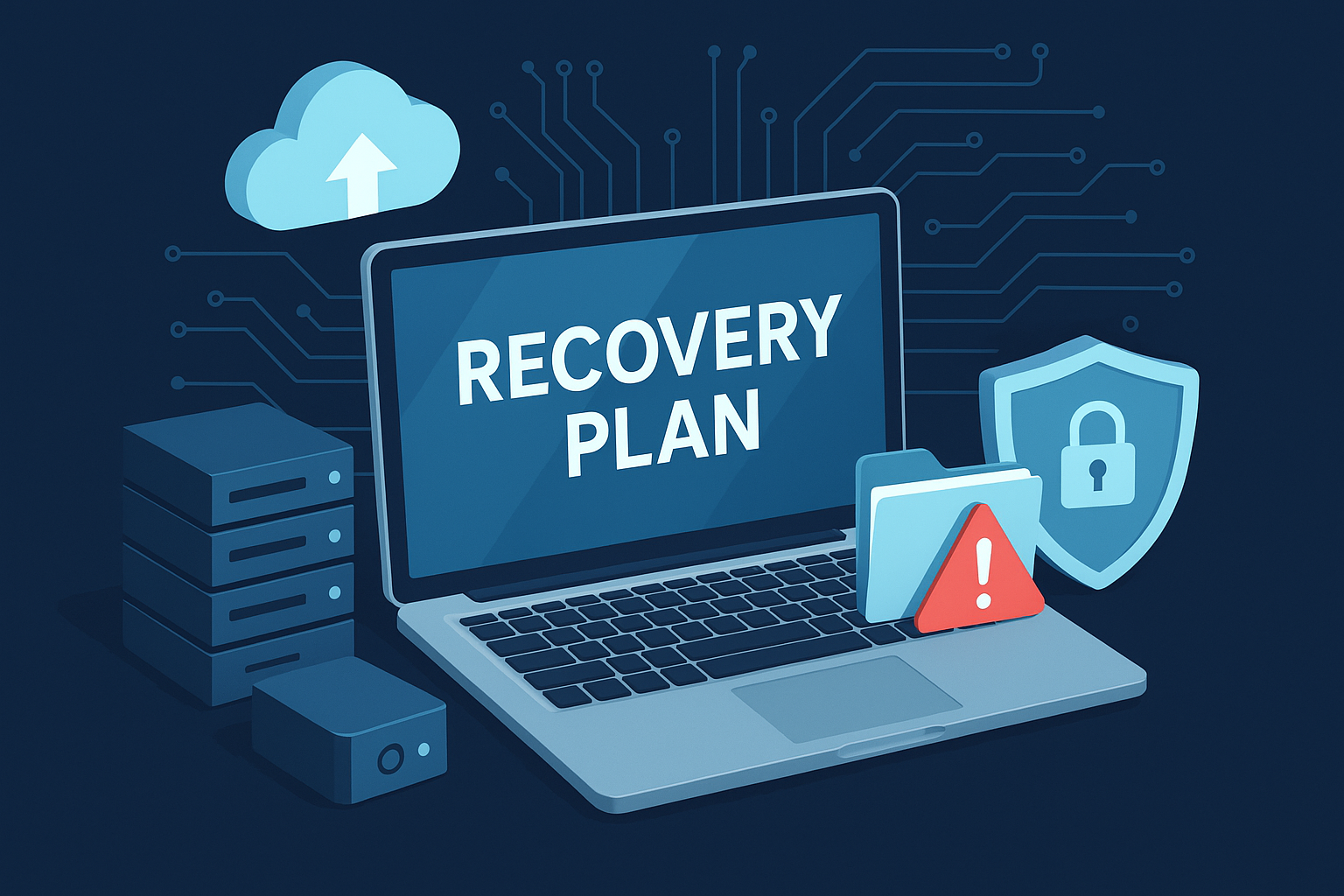
Imagine your business suffers a major data breach. Or maybe a burst pipe floods your server room. Or what if a random human error deletes a critical customer database? What happens next?
Here’s the thing, unfortunately, for many small businesses, the answer is chaos. Without a clear plan, a single unexpected event can sink an otherwise well-functioning business. That’s why we believe in having a Disaster Recovery Plan. This guide will walk you through creating a plan that protects your business when the unexpected strikes.
What is a significant but solvable disaster for a big business can be company-ending for a small one. Small businesses are, unfortunately, often more vulnerable to cyber attacks due to having less budget to spend on security.
They also tend to have fewer resources to absorb problems as they arise, with spare resources. Even a single day when operations are disrupted can harm one’s reputation for years to come.
All this is to say that a Disaster Recovery Plan can be your most powerful shield against the worst aspects of service disruptions. It ensures that you can restore critical functions quickly, minimize loss, and protect your reputation with customers. This can be the difference between a temporary setback and a permanent closure.
Before you can plan for recovery, you need to know what you’re up against.
There are the obvious threats, like cyberattacks, which will be much discussed. But for a proper disaster recovery plan, you need to consider rarer problems, like floods, fires, and storms. There can also be cascading hardware failures or human errors causing large-scale shutdowns.
It’s important to know what absolutely needs to stay online vs. what you can afford to lose, at least temporarily. Getting mission-critical operations online is priority one, but only if you know what those operations are. Typical pieces considered mission-critical include your e-commerce platform, customer service, and payroll processing.
Finally, it’s a good idea to figure out the cost of any disruption. How much revenue is lost per hour of downtime? What are the legal or contractual penalties?
These are the primary objectives of your plan: recovery time objective (RTT) and recovery point objective (RPO).
This is the upper limit of what you consider acceptable downtime. Of course, no downtime is ideal, but we live in a non-ideal world. So, it’s crucial to figure out your answer to the question: “How fast do we have to be back up and running before things get really bad?” Two-hour RTO means you need a solution that restores the system within two hours.
Instead of downtime, RPO is your maximum acceptable data loss. It answers, “How much recent data can we afford to lose?” A four-hour RPO means your backups must capture data at least every four hours.
You have to be realistic, looking at how other businesses in your sector handle these. The faster you want your RTO and RPO, the more expensive it gets. That’s why, for many small businesses, an RTO of a few hours and an RPO of one business day are considered acceptable.
A plan is useless without people to execute it. That’s where your team comes in.
Who declares a disaster? Who manages the technical recovery? Who communicates with employees and customers? It’s time to define these roles clearly. Assign a lead and at least one backup for each for maximum success.
Keep an updated, off-site list of all team members’ contact information. In it, you should include their phone numbers and emails for on-call contact.
Training should be provided to everyone to ensure they understand
their role during a disaster. Conduct walkthroughs. Cross-train team members so no single person has the pressure of being the be-all and end-all.
Now, it’s time to build the step-by-step instruction manual for recovery.
To build a strong recovery plan, start with backups. The 3-2-1 rule is your friend. Have at least three total copies of your data. Store two copies in different ways. And keep one copy off-site. After doing that, also check for your backups and test them regularly.
Next, consider what happens if your office becomes inaccessible. Do you have a temporary workspace? Do employees have laptops available for remote work? There are solutions to many of these problems nowadays, so it’s essential to utilize them to stay competitive.
Finally, evaluate your disaster recovery options. For most small businesses, cloud-based recovery solutions are more affordable and manageable. It works by quickly spinning up virtual servers in a secure data center, avoiding the cost and complexity of maintaining a duplicate physical site.
Chaos demands clear communication. Protocols and lines of communication are vital.
Ask yourself: how will the DR team communicate? How will all employees be notified? Utilize multiple channels, such as text messages, a phone tree, and a pre-established status page, to connect through various streams.
Prepare template messages for customers and partners, being honest and transparent about the situation and your progress. Everyone comes out better when they are in the loop.
Define what specific event officially activates the plan. Is it a 12-hour server outage? A confirmed ransomware attack? Clear triggers for different paths on the disaster recovery plan are crucial to acting fast and effectively.
An untested plan can spell its own kind of disaster. You have to check if it works.
Start with a simple tabletop exercise where the team walks through a scenario. Progress to a simulation that tests technical recovery without interrupting live systems. The ultimate test is a full failover, but it’s not necessary to go this far to be useful.
Review your plan at least every six months to ensure it remains effective and conduct a tabletop drill annually. As your technology and staff evolve, your plan must adapt accordingly.
Any major change should trigger a plan review. Did you launch a new product? Switch accounting software? Add new staff? Update your plan immediately.
Finally, a plan must fit within a budget.
Weigh the cost of each potential plan with the expected financial loss from an incident and plan accordingly. This is also how you can justify the expense to stakeholders.
There are also more cloud backup and Disaster-Recovery-as-a-Service (DRaaS) providers offering scalable, subscription-based plans that are cost-effective for small businesses.
Finally, you can start considering cyber insurance to offset disaster costs. This can save you in cases where a catastrophe comes through, even with good security and providers.
Unfortunately, the most common mistake is freezing and doing nothing. While tempting, this doesn’t work in the long run. Others include:
A simple plan is infinitely better than no plan at all.
In 2023, family-owned business G&J Pepsi was hit with ransomware that encrypted its critical systems overnight, rendering them unusable. Attackers used advanced tools to spread through their network, but G&J had moved most of its operations to Microsoft Azure and kept platform-level backups isolated from the attack surface; they were able to implement their disaster recovery plan quickly. Within hours, the IT team shut down compromised virtual machines, prioritized restoring domain controllers and essential services, and began rebuilding affected systems.
Core business functions were back online in about seven hours, without having to pay a ransom. This just goes to show how effective a robust disaster recovery plan can be. In this case, their endpoints took longer to recover, with over a hundred machines having to be wiped and rebuilt. However, through communication with their cloud tools, they could continue to work mostly unimpeded. In the end, their downtime was limited to a single workday, which is pretty good.
Building your disaster recovery plan is a smart goal for leadership. While things are easy when everything is going well, the true resolve of a company is revealed when disaster strikes. Don’t let it happen before you’re ready. Start today, and build up your disaster recovery plan over time.
Get A FREE Subscription To Weekly Cybersecurity Tips So Your Company Doesn’t Become The Next Victim.