
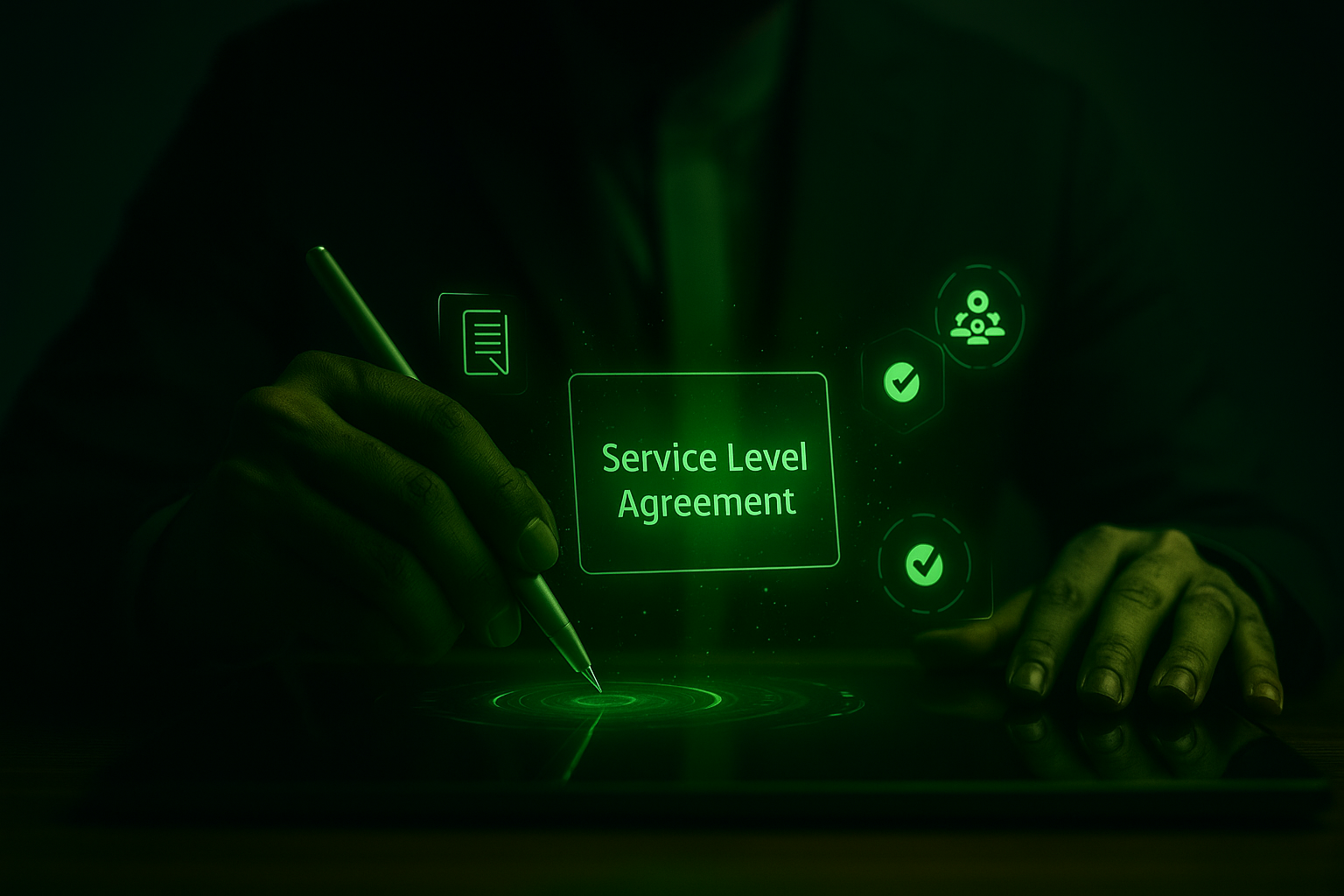
An SLA is the contract you sign when you partner with an IT service Provider or Managed Service Provider (MSP). Because such services involve many moving parts, like maintenance, security, and updates, it’s essential to get what you need in writing. The SLA is the bedrock of your partnership, listing what to expect from the provider in accountable, measurable terms.
At Tecbound, a strong, clear SLA is the primary key to a good working relationship between companies.
An SLA is a formal commitment between a service provider and a client. It defines the level of service the client can expect, using specific, quantifiable metrics.
For any business relying on external IT support, the SLA is the contract that ensures both parties are honest and accountable. It moves the relationship from vague promises of “good service” to concrete obligations the provider commits to with clear penalties for failure based on objective measures.
Ultimately, the SLA directly impacts your business’s operational stability by defining what reliable service delivery actually looks like from the provider, and should never be overlooked.
Understanding the language of an SLA is crucial to evaluating a provider’s offer. Here’s what the main terms mean.
Typically considered the most critical figure in the SLA, this is your guarantee of uptime for your systems. Uptime refers to the period during which your services are operational and accessible. If either of these fails, you’re in downtime, and this counts against the SLA. A standard figure is a 99.9% uptime guarantee, which translates to approximately 8 hours and 45 minutes of downtime per year. Most businesses can withstand this much downtime without too much trouble, and guaranteeing even less downtime is costly.
This distinction is tricky, but essential. Response time refers to the speed at which the provider identifies an issue and assigns it a ticket number. Resolution time refers to the duration it takes to actually resolve an issue. These are entirely different timeframes, but both are important. Some providers achieve fantastic response times, which can make them appear great on the surface, but often lack effective resolution times, leading to more downtime and frustration in the long run.
Digging into things, there is a difference between your systems being ‘up,’ and how well they actually perform. There should be a section in the SLA dedicated to Key Performance Indicators (KPIs) to monitor factors such as network latency, server processing speed, and help desk efficiency, ensuring that it’s not just uptime, but also useful uptime.
When using a provider, you need to be able to contact them when things go wrong. Most advertise “24/7 support,” but it’s essential to check whether that means you can connect to a live person within a reasonable time frame, or if it’s just a connection to their AI or automated answering service. The SLA should provide detailed information on this, including expected wait times, contact methods, and the level of after-hours support that can assist you.
Of course, one hopes it never gets this far, but it is essential to know the actual penalties if the provider breaches its contract. This section is typically referred to as “Service Credits”. It explains the financial and service-based penalties the provider offers if it misses its targets, usually by crediting a portion of your monthly fee. Read this carefully and compare it with similar providers to understand what’s reasonable.
Read your SLA carefully. Some yellow to red flags include:
If it appears to be intentionally designed to be difficult to understand or enforce, it probably is.
Here’s a basic explainer for what to look for in an SLA before you sign.
At Tecbound, our approach to SLAs is built on proactive performance and absolute accountability. We do not view the SLA as a distant target, but rather as a baseline for our daily operations.
That’s why we’ve made our guarantees clear, strong, and designed with customer success in mind from the start. We combine industry-leading technology with a customer-centric support philosophy, ensuring we not only meet our contractual obligations but also exceed your service expectations.
We deliver trust, transparency, and measurable results. Discover our commitment to reliable, SLA-backed IT services on our dedicated services page.
As we’ve seen, the SLA is the definitive blueprint to your IT partnership. A thorough understanding of its terms enables you to determine if you have the right provider for your needs and how to hold them accountable. Don’t settle for vague assurances. Demand a transparent, fair, and robust SLA.
Get A FREE Subscription To Weekly Cybersecurity Tips So Your Company Doesn’t Become The Next Victim.